Team Structure
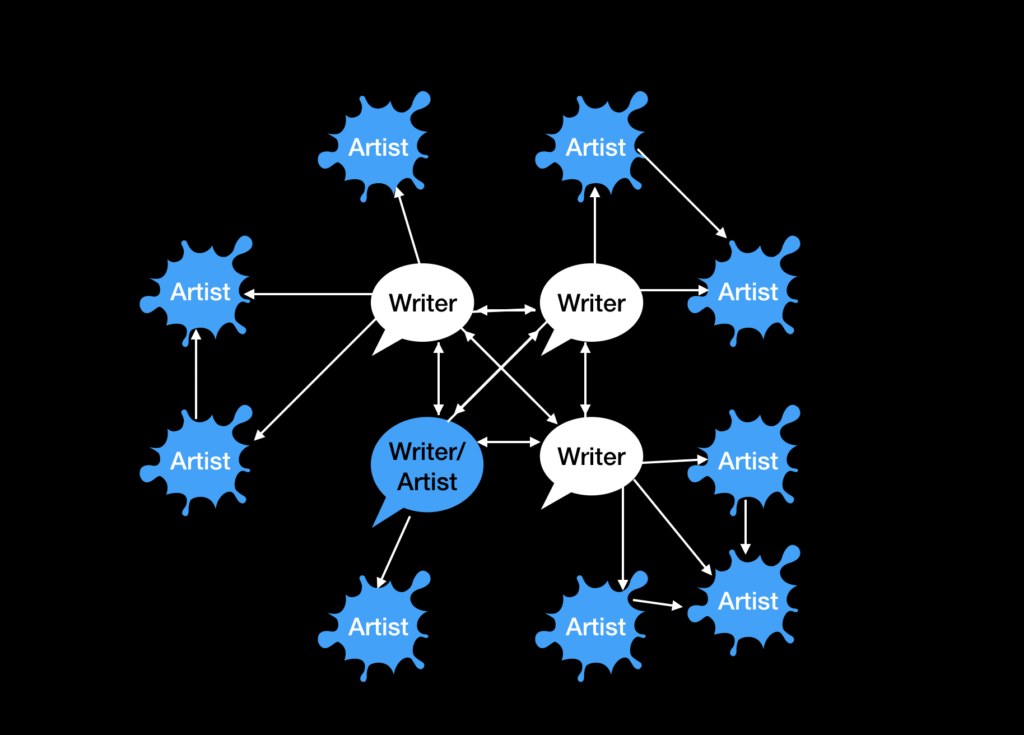
The basic structure for a 48 hour graphic novel team is based around making sure everyone has a clear role in the process.
The writers work together as a team. They plot out the story, and plan together.
Each writer has a team of 2 or more artists. In fact, the writer might also be an artist. The writer is in charge of that group of artists, and they all work together to get the story told that the writer wants to tell (though the writer should also attempt to tell a story that utilizes the skills of the artist).
Throughout the 48 hour period, artists should feel free to trade to other teams. This might not be good for everyone (especially if you get into a good flow with your team mates), but it’s a good opportunity to work with different people, and to network. Writer’s would do well to watch out for artists who are drawing in a style that would work well with your story, too.
Head writer
I advise you to pick a head writer in the beginning of the event. This person can still tell their own part of the story, but will be tasked with keeping an overview on everyone else’s strands of the story. It’s especially good so that you have one person in a position to say what’s needed in the story to fill gaps and connections between stories.
This head writer concept comes from TV writing, where you have the showrunner for a TV show, with a room of writers putting together the overall story. The showrunner’s job is to make it all hang well together and fit as pieces of a whole.
Different styles of working
There are many different styles of creating comics.
- Single Artist “teams” are the norm in the EU and sometimes in the US. What this means is that everything is done by one person.
- Pencilers and Inkers are common in US comics, where the work is more of an assembly line of creators. The two creators split the work, with the penciler drawing the image and the inker applying ink to make it ready for printing.
- Roughs and Finishes are also often used in US comics, taking this idea tot he extreme. In it, one artist provides rough sketches of what they want, and the finisher fills out the art completely, filling in all of the details.
- Background and character artists. This is how things work in animation usually, but also often in Japanese Manga where backgrounds might be drawn or purchased separately.
- Whatever method works for you. Honestly, while people will tell you there are rules, all anyone ever cares about at the printed pages.
With the first GNW, we wanted to have 2 person art teams to allow for the USA Penciler/Inker, Roughs/Finishes, or backgrounds/characters methodology. And while these are designed to each be a time saving process, you can also always just use the two person teams to get more art done by having two people drawing. In any event, part of the value of the event is getting people working together, communicating, and making connections.
The goal is to allow every team to produce as many pages as they can – but unlike 24 hour comic day, you’re not expected to each do 24 pages on your own – Actually, so far as expectations go, some people work fast, some people work slowly and highly details. At the end of the day, you hope to have a mix of the two working for every writer.
Post-production during the even, where possible
It’s really very useful to do the post-production on site during the event. This gives the chance for writers to have more control over their dialogue, and for everyone to see the project come together. The minute you get away from the event, everyone has to remember their intention, and meetings have to be pulled together.
This is why it’s very recommended to have a team well versed in printing, layout, and all of the digital processes that will be necessary. This is a full time job, and so I recommend (from experience) that you plan for it, and accept that it will take a lot of work.
Comments are closed.